
My personal philosophy of education is generally based on a Progressive theory with hints of Idealism, Realism, and Pragmatism. I believe that it’s important to relate the content we’re teaching to real world issues and that all teachers, trainers, and designers have an obligation to foster a sense of learning in every learner. I believe that schools, both traditional and virtual, can act as agents of social change and education should concern itself with educating holistically – not just providing learners the ability to regurgitate memorized facts for standardized tests or ticking a box for mandatory professional development. There should be a strong emphasis on problem solving, critical thinking and collaborative learning. My favorite strategies involve utilizing problem-based and project-based learning to foster communication, collaboration, comprehension, and engagement although I struggle with how to incorporate tactile projects in the online learning environment.
All learners should feel as sense of connectedness to the classroom in which they belong. Environments can greatly affect learning in both positive and negative ways and care should be taken to create a space (physical or virtual) that fosters a sense of belonging. Learners who feel that they are in an environment with which they connect are more likely to freely express themselves and engage with others and content. My goal has always been to have learners become energized by their learning so that they when they leave my course(s) they want to learn even more about the topics we covered. The greatest reward for any educator is to create a sense of hunger through which learners are motivated to continue learning.
Learning should be structured so that lessons are appealing and appropriate for learners of differing styles. When designing an online course, I would need to identify the different needs and learning styles of my participants early in the planning process so that I can create lessons that meet these needs and styles. Differentiation can allow for student growth if well developed. It requires a significant amount of time on the part of the designer and it can be difficult to balance lessons so that all learning styles are addressed properly and with equity. Providing a variety of methods through which participants can learn can help to increase motivation. Learners who have the opportunity to learn via the method that is most appropriate for them will likely be more engaged than those who are required to learn through methods/styles that are not tailored to them. This philosophy is the overarching theory of “Backward Design” (illustrated below).
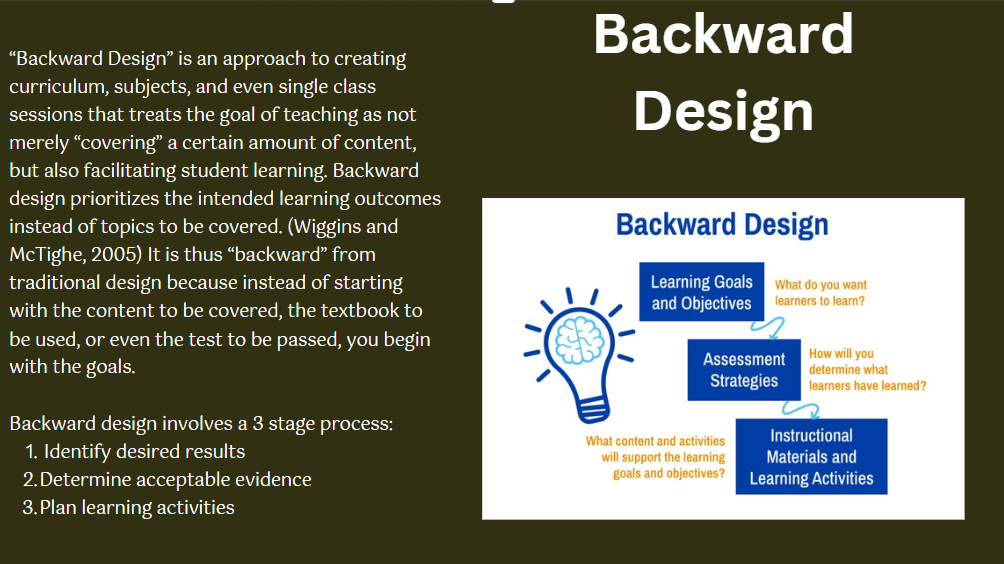
Furthermore, I believe that assessment deserves an equal seat at the table in any course design. Such assessments should include a variety of formats to align with the goals of the program. Some assessment types include portfolios, presentations, essays, journals, peer review, demonstrations, projects, and both written and oral examinations. These assessments can be used in either traditional face to face as well as hybrid or wholly online learning environments. When we only use one method of assessment to determine success at initially learning the material we are unable to form a comprehensive view of the knowledge, comprehension, and growth of a learner and we also do not consider variances in culture. In our ever-changing and increasingly inter-connected world, learners must be able to adapt quickly to change and should have the ability to view problems and concepts from multiple perspectives.
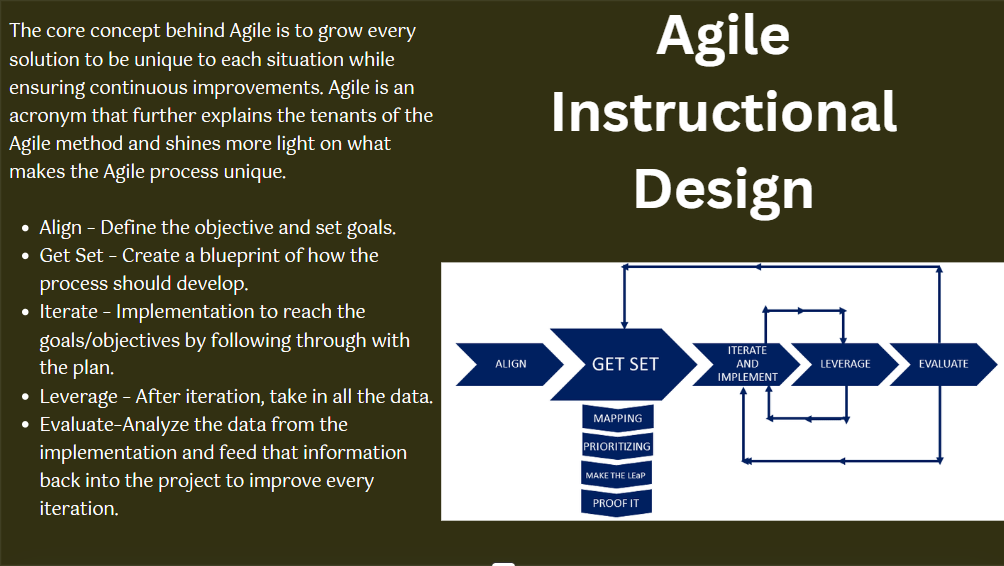
Finally, in order to successfully implement a course, evaluation is paramount. The “ADDIE” method of instructional design takes up most of the air in this conversation, currently. However, I’ve recently prescribed to a different theory, also an acronym, AGILE instructional design promotes constant movement between the individual parts. Evaluation doesn’t mean you start the process over in a circle, as in the ADDIE method, but it instead encourages fluidity of evaluation and revision.



 Jessica Adams: Instructional Design Specialist